Blackout Shades

Noblesville Blackout Shades From Noblesville Window Treatments

Darkness is scope and channels, not just fabric

Call (317) 999-5154Get Free Quote
Quick Answer

Here's the detail behind the product description. What it's made of, how it's sized, what drives the price, how long it takes to build and what the manufacturer covers if it fails.

  • Service: Blackout Shades for Noblesville homeowners
  • Service area: Noblesville, IN and surrounding areas
  • Two different timelines apply. New custom product takes weeks because it has to be made. Repairs to what's already hanging, a cord lock, a ladder string, a chain that jumped the clutch, are usually far quicker.
  • Insured and bonded
  • Serving Noblesville, IN since 2008
Blackout Shades Services

Expert Blackout Shades for Noblesville Homes

Blackout is an assembly, not a fabric, and getting that wrong is the most common disappointment in this trade. A blackout fabric on an inside mount gives you a dark shade with light around it. Lutron publishes an inside mount gap of three quarters of an inch per side on its Roller 20 and 64 systems and thirteen sixteenths on the larger ones, with a factory deduction of a sixteenth per side, and that light is by design. We tell you the number in inches before you order rather than after you've hung it.

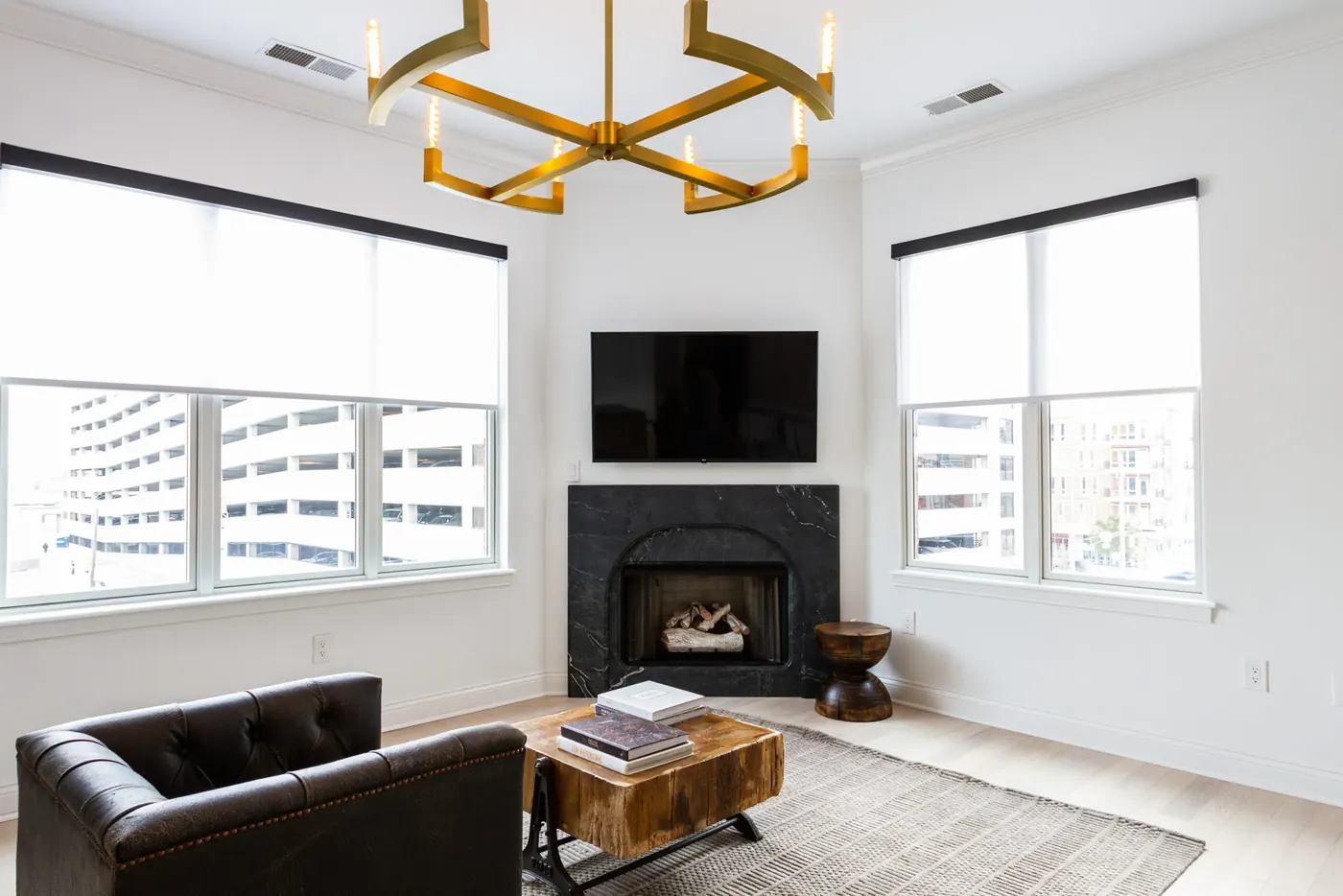
Real darkness comes from three things done together: a fabric that blocks light, a mount that overlaps the opening generously or side channels that close the edges, and something at the head that stops light coming over the top. Any two of those without the third leaves a visible line somewhere. On a Noblesville bedroom facing east, that line is exactly where the June sunrise lands at half past five, which is why people notice it on the first clear morning after installation.

The two Noblesville versions of this job differ. In a 2024 Del Webb single level at Finch Creek the opening is square and deep with a square set drywall return, so the answer is usually an outside mount with real overlap or a pocketed head detail worked out before the drywall closes. In an 1890s bedroom north of the square, the opening is racked and the casing has profile, so an outside mount on the casing face with a light blocking pocket is what actually gets the room dark.

When to Call

Signs You Need Blackout Shades

If you notice any of these in your Noblesville home, it is worth booking a measure. None of it is urgent, and none of it fixes itself either.

The bedroom is bright by half past five in June

A shift worker sleeps during daylight hours

Light leaks around the edges of an existing blackout shade

A media room washes out on sunny afternoons

A nursery has to stay dark through an afternoon nap

Street lights come through the shade at night

The current shade is dark but the room isn't

A hotel or short term rental room needs consistent darkness

Our Process

How Noblesville Window Treatments Handles Blackout Shades

Every job follows the same six-step process. Transparent, thorough, and done right the first time.

1

Agree what dark means here

There's a difference between a room dark enough to sleep in and a room dark enough to grade a projector image. We ask which one you want, because the second costs meaningfully more and involves details the first doesn't need. Getting that agreed early stops a specification being judged against an expectation it was never priced for.

2

Measure, then write the gap

Three widths, three heights and a diagonal, and then the light gap for any inside mounted option gets written on the quote in inches. Shades over 120 inches tall or past a four to one height to width ratio get larger gaps, and that's stated too. If the number is unacceptable, we change the approach right there rather than proceeding and hoping.

3

Choose the closure method

Side channels close the edges and give the best result. A light blocking pocket at the head stops the light that comes over the top. An outside mount with generous overlap on all sides is the simpler route and works well where the wall around the opening is flat and clear. In an older house with deep casing, the casing itself often provides the surface that makes this work.

4

Pick fabric and backing

Blackout roller fabric, blackout cellular and a lined Roman all behave differently. Roller fabric with channels is the tightest. Cellular adds thermal performance against a January night and a smaller stack. A Roman shade with blackout lining is the most decorative and the least absolute, since the lift system creates light pathways through the shade itself.

5

Flag the condensation risk

A tight blackout assembly against cold glass in a Noblesville winter traps moisture between the shade and the window. Dark spotting along the bottom rail and a musty smell are the symptoms, and side channels make it worse rather than better. We identify the rooms at risk, adjust the detail and tell you what air movement the room needs before you find out in February.

6

Install and test in the dark

Brackets level, channels plumb and parallel, the head detail closed. Then the real test: the room gets shut up and looked at with the lights off so any remaining leak shows. Fixing a light path while we're still on site takes minutes. Discovering it at five in the morning three weeks later takes a return visit and a conversation nobody wants.

Real Project Photos

Blackout Shades in Noblesville

Photographs from real blackout shades jobs completed by our crew in Noblesville and surrounding areas.
Custom shades measured and installed in NoblesvillePlantation shutters fitted to a Noblesville windowCellular shades in a Noblesville living room
Scope of Work

What Blackout Shades Includes

Every Noblesville job is documented item by item. Here is what the crew covers.

The actual goal settled first, since a room dark enough to sleep in and a genuinely dark room need different products

Every opening measured and checked on the diagonal, because a shade hanging out of level leaks down one side

Outside light sources logged at the measure: a street lamp, a security light, headlights sweeping a bend

Wall surface above and beside the opening checked for somewhere flat and solid to land channels

Outside mount specified wherever real darkness is the goal, with overlap written in inches on every side

Side channels specified where the room has to be dark and the wall around the opening will take them

A light-blocking pocket or a closed cassette specified at the top so daylight can't come over the roller

Factory deduction disclosed up front, since Lutron publishes 1/16 inch per side and that width has to go somewhere

Inside-mount light gap stated in writing, using Lutron's published 3/4 inch per side on Roller 20/64

Tall or narrow units flagged, because shades past 120 inches or a 4:1 height-to-width ratio get larger gaps

The bottom of the shade addressed on its own: hembar position, sill depth and light bouncing off the sill

Fabric named honestly as room darkening or blackout on the order, because the two aren't the same thing

Seam construction checked on any fabric going into a room that has to be dark, so needle holes don't become pinholes of light

Wall and ceiling color discussed, since a bright white room bounces whatever daylight does get past the shade

Cordless or motorized lift specified in nurseries and kids' rooms, to ANSI/WCMA A100.1-2022

Layering planned where one product can't finish the job, such as a blackout roller under lined panels

Channels fastened plumb down both sides, since a bowed track opens a gap of its own

The finished shade run through full travel and looked at with the room lights off, in daylight, before we leave

Pricing

What Blackout Shades Cost in Noblesville

National figures put stock shades at roughly $60 to $600 per window and custom-fabricated shades at roughly $250 to $2,600 per window. Those are national ranges for a category and not a quote for a bedroom in Noblesville. Blackout has a wrinkle the other categories don't: the fabric is rarely the expensive part. Getting a room actually dark means an outside mount with real overlap, side channels down both sides and a pocket or closed cassette at the top, and that hardware can cost as much as the shade it surrounds. A bare blackout roller is cheap and it will disappoint you. Noblesville Window Treatments prices the whole assembly for Hamilton County rooms, because pricing the fabric alone is how customers end up unhappy.

By Product

How Blackout Shades Differ by Product

Every product in this trade behaves differently in a room. Here is what that means for this work.

Blackout roller shade: A dense coated fabric on a tube, the workhorse of this category. The cloth itself passes essentially no light. Everything about whether the room goes dark comes down to what you put around the edges of it, not the fabric you picked.

Blackout cellular shade: A honeycomb with a blackout layer inside the cells, which adds an insulating air pocket the roller doesn't have. It's the better choice on a cold bedroom window in January, and it pairs with side tracks the same way a roller does.

Side channels: Aluminum or vinyl tracks running down both sides that capture the fabric edge. This is the single component that turns a dark shade into a dark room. They're visible, they add width to the outside of the opening, and they need a flat mounting surface.

Light-blocking pocket: A three-sided box mounted above the shade that closes off the top and the upper corners. Light comes over a roller as easily as around it, and a pocket is what shuts that path without relying on the fabric wrapping the tube.

Closed cassette: A headrail enclosing the roller on all sides with a fabric slot at the bottom. It handles the top gap the way a pocket does while looking like finished hardware rather than a built element, and it suits a wall with no depth above.

Outside mount with overlap: Mounting past the trim on all four sides, so the fabric covers more than the opening. The cheapest real improvement in this category. Two or three inches of overlap per side does more for darkness than upgrading the fabric ever will.

Room darkening fabric: A fabric that cuts most light without being opaque, usually with a soft glow through the cloth. It's enough for a guest room or a den, it costs less, and calling it blackout is the most common mislabeling in this trade.

Dual shade on one bracket: A solar screen and a blackout shade on a single bracket set, operated separately. You keep the view and glare control during the day and drop the blackout at night, which is how a bedroom that's also a sitting room gets solved.

Motorized blackout: A motor lets a channeled shade run its full travel without anyone fighting a track, and it puts a dark room on a schedule. On battery, expect to change or recharge roughly once a year, which is the cost nobody mentions at the sale.

Blackout lined drapery over a shade: Panels handle the softness and the sides while the shade handles the glass. The combination reaches a level of darkness neither one gets to alone, and it's often the better-looking answer in a primary bedroom.

Light Control

See What Each Fabric Does To The Light

Pick a fabric below and the window updates. It's a drawing rather than a photograph, so read it as a rough guide to what each family does in a Noblesville room, and to what it doesn't do.

Fabric type

Sheer, 10 percent openness

Ten percent of the weave is open, so you keep the view and most of the daylight. Glare drops a little. After dark, once your lamps are on, someone outside can read shapes through it, which is why this belongs on a view window rather than a bedroom.

Openness factor is printed on the fabric card, so you can compare one line against another before you order anything.

Keeps the viewNot private after dark

Solar, 5 percent openness

The usual pick for a west window or a covered porch. You can still read the yard through it, glare comes down noticeably, and the fabric intercepts a good share of the sun before it reaches you at four in the afternoon.

It also cuts the UV landing on floors and furniture. NFRC puts UV at roughly 40 to 60 percent of fading damage, so this slows fading rather than stopping it.

View and glare controlSlows fading

Solar, 3 percent openness

A tighter weave. The room goes dimmer and the view drops back to an outline. Choose it where the sun is the problem and the view is second, which around here usually means a west wall in July. That's a common call on this side of Indianapolis.

Openness affects how much you see out, not how private you are. A 3 percent fabric still shows silhouettes at night.

View becomes an outlineStrong glare control

Solar, 1 percent openness

Close to a solid fabric with a little view left in it. This is the strongest glare control in the solar family.

The trade is that it darkens the room on a gray January day too. Indianapolis averages a January high near 36F and the light is flat, so think about how the room reads in both seasons before you commit.

Darkest solar optionDim on gray days

Light filtering

No view through it. Daylight comes through the face diffused, so the room stays bright without a hot spot across the television or the kitchen island. This is the default for living spaces.

It isn't private in reverse at night. With the lamps on and the sun down, silhouettes still show.

No view through itBright without the glare

Room darkening

A denser fabric, usually with a liner behind it. Most of the light coming through the face is gone.

Light still arrives around the edges on an inside mount, so a room darkening shade gives you a dim room rather than a dark one. If someone in the house sleeps during the day, say so at the measure and we'll scope it differently.

Dim, not darkEdges stay bright

Blackout

The fabric itself passes essentially no light. What you'll still see is the perimeter. Lutron publishes an inside-mount light gap of about 3/4 inch per side on its Roller 20 and 64 shades, along with a standard factory deduction of 1/16 inch per side, and shades over 120 inches tall or past a 4:1 height-to-width ratio get larger gaps than that.

So if you need a genuinely dark bedroom, that gap has to be dealt with on purpose, either with side channels or by going outside mount. We tell you which one your opening can carry while we're still standing in the room.

Dark facePerimeter needs a plan

Openness factor is a measured fabric spec, so you can compare it line to line. The category names are not measured. One maker's room darkening can behave like another maker's light filtering, which is why the sample books come to the measure and get opened in the room they're going in, at the hour that room has the problem.

Common Questions

Blackout Shades FAQ

Questions we hear most often from Noblesville homeowners considering blackout shades.

Because the fabric is blackout and the installation isn't. On an inside mount there's a designed gap at each side, and light also comes over the top of the roll unless something closes the head. Both are normal and both are fixable. Side channels close the edges, a light blocking pocket closes the head, and an outside mount with real overlap does a lot of the same work more simply. None of that's a fabric upgrade, it's scope, and it should have been quoted with the shade.
Genuinely dark, with the right assembly. Fabric, channels at both edges and a closed head detail together will get a bedroom to the point where you can't read in it at midday. What defeats it in practice is usually something outside the shade: a gap under the door, a light switch panel glowing, or a window in an adjoining room throwing light down a hallway. When a room has to be truly dark we look at all of that rather than only at the window. There's a measurable way to check before you spend. Sit in the room with the existing covering closed for five minutes and let your eyes adjust.
Roller with side channels is the tighter light control. Cellular does more thermally, which matters against a 20.9F January night, and it stacks smaller, which matters on the tall narrow openings in the older parts of the city. Cellular blackout also has more edges for light to find, so it needs channels more than roller does. In a bedroom that's cold as well as bright, cellular usually wins. In a media room, roller. There's a third option for a room that has to be dark and also has to look like a bedroom. A blackout roller behind a decorative Roman shade or a drapery panel gives you the tight light control from a plain product and the appearance from the one in front, on separate operating systems.
Usually yes, and the answer is generally an outside mount rather than channels. In a house north or south of the square, the original casing gives you a wide flat surface to mount over, so a shade sized past the casing edge overlaps the opening completely with nothing hardware looking screwed to the frame. Add a decorative valance or a drapery panel over the top and the light control disappears behind something that suits the room. There's a second period specific advantage. Because the casing in these houses is deep, an outside mounted board sits proud enough that the shade hangs clear of the glass, which reduces the condensation problem a tight channel assembly would create against a cold window in January.
With glare and with the direct beam, yes. With heat, less than you'd hope, because by the time an interior fabric sees the energy it's already inside the room. On a west elevation the more effective spend is stopping it outside with an exterior shade or an awning, or cutting it at the glass with a low openness solar fabric during the day. Blackout is the right product for darkness and a partial answer for temperature. There's a night time exception worth naming. A blackout assembly closed over a window on a winter evening does put fabric and a still air layer between the room and cold glass, so it does real work against heat loss even though it does little against summer heat gain.
It's the service call we see most on this product in this climate. Noblesville gives you a long humid season and then a dry heated winter, and cold glass in January pulls moisture out of the room air. A tightly sealed blackout assembly holds that moisture against the glass, and the result is spotting along the bottom rail and staining on the room side. It's manageable with the right mount, a little air movement and awareness. It isn't manageable if nobody mentions it. There's a straightforward mitigation people can act on. Raising the shade for part of the day lets the glass and the fabric dry, and running a bathroom or kitchen extractor for longer after use cuts the moisture load in the room.
A head detail. If you know a bedroom needs true blackout, the cheapest version of that's a recessed pocket at the ceiling, framed and drywalled before the finish work, so the shade drops out of a slot instead of hanging off a bracket. That has to be decided at framing or drywall, not at closing. Since the houses there are being finished right now, it's worth having the conversation while there's still a chance to act on it. There's a second thing worth asking for at the same stage. Blocking behind the drywall at the head of any opening that will carry a heavy treatment costs almost nothing while the wall is open and saves specifying anchors into plain board later. Builders will usually do it if asked in writing.
Sometimes, and it depends on the product. If the existing shade is a roller with a suitable fabric and the width allows for channels either side, it can often be done and it costs far less than starting again. If the existing shade is already tight to the opening, adding channels means a narrower shade, which means new fabric, which means a new shade. We'll measure and tell you which of those you're looking at before you spend anything.
Because the fabric was never the problem. A blackout cloth passes essentially no light through itself, which is the easy part. What leaks is the perimeter. An inside-mounted shade has to be narrower than the opening to move at all, so there's a gap down each side, plus a path over the top of the roller and a gap at the bottom where the hembar sits off the sill. Nothing about the fabric grade changes that geometry. Only the mount and the hardware around it do.
Room darkening fabric cuts most of the light but still glows softly when the sun hits it. Blackout fabric is opaque, and you can hold it to a lamp and see nothing. The difference matters because the words get used interchangeably in advertising and they aren't interchangeable at all. For a guest room or a den, room darkening is usually plenty and it costs less. For a nursery at 6am in June, room darkening will not do what you're hoping.
Not on its own. Lutron publishes an inside-mount light gap of 3/4 inch per side on Roller 20/64, plus a standard factory deduction of 1/16 inch per side, and every manufacturer has a version of the same numbers. That gap is what lets the shade travel without dragging. You can close it with side channels fastened inside the opening, and that combination does work. An inside mount with no channels, in a bedroom, is going to leave two vertical stripes of daylight on your wall.
They're tracks, usually aluminum, that run the height of the window on both sides and capture the edge of the fabric so light can't get past. Visually they read as two slim vertical pieces of hardware, and they come in finishes that can match a headrail or blend with trim. They add width outside the opening on an outside mount, and they need a flat, solid surface to fasten to. In a room that has to be dark, they earn their appearance.
It's a three-sided enclosure mounted above the shade that closes off the top and both upper corners. People concentrate on the sides and forget that a roller shade has an open path over the tube, where daylight comes down behind the fabric and lands on the wall. A pocket or a fully closed cassette shuts that path. Combined with channels down the sides and an overlapping outside mount, that's the assembly that actually produces a dark room in Noblesville.
More than the default. Mounting past the trim on all four sides is the cheapest real improvement available in this category, and a couple of inches per side does more for darkness than moving up a fabric grade. Above the opening you want enough height for the roller and the pocket. Below, the shade should run past the sill rather than stopping at it. We dimension the overlap at the measure and write it on the order rather than leaving it to a factory standard.
Yes, and it surprises people. A hembar hangs a fraction off the sill so it can move, and low morning sun coming in at an angle finds that gap and reflects off the sill into the room. It's a smaller leak than the sides but it's real. Running the shade past the sill on an outside mount handles it. A bottom channel or a hembar seal handles it in the rooms where nothing less will do. We check it standing in the room, not on paper.
Cordless or motorized, always, since ANSI/WCMA A100.1-2022 is the safety standard this trade builds to and non-compliant inner cords are a substantial product hazard under 16 CFR 1120.3. For darkness, a blackout cellular or roller mounted outside the opening with generous overlap, side channels down both sides and a pocket at the top. And a conversation about the wall color, because a white ceiling will happily bounce whatever daylight finds a way in and undo half of what you paid for.
The full assembly, and layering on top of it. Shift sleep means the sun is at its strongest while you're trying to be unconscious, which is the hardest version of this problem. We'd specify a blackout shade mounted outside the opening with channels and a top pocket, then blackout lined panels over it to catch anything at the perimeter and to soften the room. It's also worth checking the door: a bright hallway under a bedroom door defeats a perfect window every time.
It helps, and a blackout cellular helps more. Stopping direct sun at the glass keeps that energy from landing on your floor and furniture, which is real on a west-facing bedroom in July when the average high around here sits at 85.2F. A cellular adds a trapped air pocket on top of that. What we won't tell you is that a shade cools a room the way a mechanical system does. It reduces the load on a hot afternoon. It doesn't replace anything.
A little, and less than the marketing suggests. A dense fabric plus a cellular air pocket takes some edge off high-frequency sound, so traffic hiss softens slightly. Low-frequency noise walks straight through. If noise is the actual complaint, layering blackout lined drapery over the shade does noticeably more than the shade alone, because you've added mass and a soft surface across a big area. We'd rather set that expectation than sell a shade on a promise it can't keep.
Yes, with two fabrics. A dual shade puts a solar screen and a blackout shade on one bracket set, each operating on its own. Through the day you run the screen, which cuts glare and heat while keeping the view. At night the blackout comes down. It costs more than a single shade and it takes more depth at the opening, so we check mounting depth carefully. In a bedroom that doubles as a sitting room, it's usually worth it.
It does, more than most people expect. Any daylight that gets past the shade lands somewhere, and a white ceiling and pale walls bounce it around the room until the whole space reads bright. The same leak in a room with deep walls barely registers. We're not going to tell you to repaint a nursery. But if you're choosing paint anyway and darkness is the goal, going darker on the ceiling does measurable work for free.
The fabric can be, and the shade can't be, and that's worth understanding before you order. Top-down bottom-up needs a movable middle rail, and that rail has to run in the same channels as everything else, which means a horizontal line where light gets through. In a bedroom that needs actual darkness, a fixed-top blackout shade is the right product and the top-down feature belongs on a different window in the house.
Free In-Home Measure

Schedule Your Free In-Home Measure in Noblesville

Contact Information

Reach Us Directly

Our team prioritizes scheduled measures and service calls, and books in-home measures during business hours.

Office
1417 Commerce Avenue, Indianapolis, IN 46201
Hours
Mon-Fri 8a-6p
Service Area
Noblesville, IN and Surrounding Areas

Ready to Book Your Measure?

Call us to set up an in-home measure, or to ask about a treatment that has stopped working. We will talk it through on the phone first.

Service area

Serving Noblesville and the surrounding area

Call NowGet Quote